Saturday, 19 September 2020

Osho going to Prostitute and Smoking

Once, I wanted to go to visit a prostitute. I was only fifteen years old and had heard that a prostitute had come to the village. My grandmother asked me, "Do you know what a prostitute means?"

I said, "I don't know exactly."

Then she said, "You must go and see, but first only go to see her sing and dance."

In India prostitutes sing and dance first, but the singing and the dancing was so third rate and the woman was so ugly that I vomited! I returned home in the middle, before the dancing and singing had finished, and before the prostituting had begun. My Nani asked, "Why have you come home so early?"

I replied, "It was nauseating."

Only later when I read Jean-Paul Sartre's book, NAUSEA, did I understand what had happened to me that night. But my grandmother even allowed me to go to a prostitute. I don't remember her ever saying no to me. I wanted to smoke; she said, "Remember one thing: smoking is okay, but always smoke in the house."

I said, "Why?"

She said, "Others may object, so you can smoke in the house. I will provide you with cigarettes."

She continued to provide me with cigarettes until I said, "Enough! I don't need any more."

Osho 
Glimpse of golden childhood
Chapter 4

Monday, 3 August 2020

Ma Taru & OSHO

Talk with Taru after discourse. She’s the jovial Indian lady who sings the sutras at the beginning of the Hindi lectures. She lives in ‘my’ guest room; an extra-large force of nature; funny, clever, full of life. She first came to Osho in 1963. We sit cross-legged opposite each other and she starts talking about the old days. Osho had left his family already at the age of seventeen. He was never much of a family-oriented person. Apparently, his sister looked after him and worked as a teacher to finance his studies.


Taru first met Osho at a panel of public lectures given by different teachers. She was drawn to him from the first moment when she heard him speak – he was so very different from the other panel-members. Among the gurus and pundits, Osho was exceptional.

She said that she had once met him on the street in Bombay, just before the Indian New Year celebration. He was carrying bags in each hand, with bottles of gin and whisky, and he asked her to come and see him later that day, at five. Together with her daughter, she sat before Osho.

“He pulled me closer and put his thumb on my third eye and I was gone… I was seeing green meadows and flowers, a blue river – I was in paradise! When it was over and I was so shaken up, Osho just smiled. ‘You will be with me for always, this is not the first time that you are with me.’ After that, I was looking after his household. My husband supported me, and he himself became Osho’s doctor.”

At that time, Osho was physically very active. “He didn’t declare his enlightenment to us and even though we knew that we were spending time with someone special, we never imagined that he was enlightened.”

She’s an imposing phenomenon, Taru, as she sits there on the bed. When she wants to emphasise something, she whacks me on the thigh, and when she tells of how Vivek took over her job as housekeeper when Osho came to Poona, the tears begin to roll down her cheeks.

Osho never had any money with him, she told me, but he always expected that we would bring him only the best of the best. He wore the finest cloth, the priciest shoes and loved exquisite food. Rich followers used to finance his constant travels all over India, and the apartment in Bombay, and his enormous collection of books, crates of which were often sent along with him on his journeys.

Taru swore that all rumours about Osho and sex were pure imagi- nation.

“I’ve met a few women who insist that they have slept with Osho. It’s not that they are consciously lying, more like they are fantasising about Osho when they are actually in bed with their own husbands!”


Saturday, 1 August 2020

Tamo San and OSHO

When she reached the age of twenty two, when she was to be ordained by the Nishi Honganji head temple of the Jodo-Shinshuu sect. While waiting in the room before the ceremony, the scroll on the wall said, “Seeing the Truth”, suddenly broke into millions of golden particle, and streamed into her body.

She saw the birth of the universe, everything in the universe and how things appeared to be separated from one another, where they are actually inseparable. Everything is essentially light and light is inseparable.

She saw that it is an illusion to think of ourselves as separate human beings, when in truth, we are born of the same life force. All of the information that poured into her mind, was so huge that it took her about ten days to assimilate.
After that experience, she understood her calling. In order to bring about everlasting peace on earth, all of mankind needs to be awakened. There is no other way! She knew that the experience she had, must be shared by every man on earth, otherwise suffering of all the living beings including the planet will never cease.

Tamo-san said, that it will take time for all of mankind to be awakened, but when it happens, it happens to all of us simultaneously. The darkest time of the day is right before dawn. Now is the dark time, so the dawn is near.
==============================================================================================================================================
Reverend Ryoju Kikuchi, a Japanese woman also known as Tamo-san, visited Pune and on the 29th of November 1989, during the meeting of the White Robe Brotherhood in Buddha Hall, Osho showered rose petals on her, acknowledging her enlightenment. Osho also gave her a copy of The Zen Manifesto, with a certificate which read, "I, Osho, as a buddha in my own right, recognise and rejoice in your enlightenment. I know, and you must be knowing, that there is one step more - going beyond enlightenment, and being nothing."
Tamo-san came to Poona because she heard Osho′s health was in danger. "I came to give my energy to Osho so that his strength would come back. He can make a big change in the world. I want to make sure that he will be well," she said.
Long time ago (1957), Tamo-san published a book, called Moor The Boat, giving her view on the world situation we are facing right now.

==============================================================================================================================================
We were sewing peacefully in the sewing room in Lao Tzu House when there was a call for Japanese Geeta to come to Neelam’s office. Someone had arrived and translating help was need. On her return Geeta told us that an old Japanese lady called Tamo–San, a priestess from a temple near Kamakura, south of Tokyo, had arrived with three disciples. She explained that she had come to visit Osho to give all her energy to him as he could reach people worldwide in a way that she could not. We were awed to hear this amazing story and were very curious to see how Osho would respond. In Buddha hall that evening I could see the exquisite tiny lady sitting in the front row with her disciples. She seemed so light and so full of light and so very still. When Osho walked on to the podium, unusually Anando came with him. I saw that she was carrying a beautifully carved brass bowl.
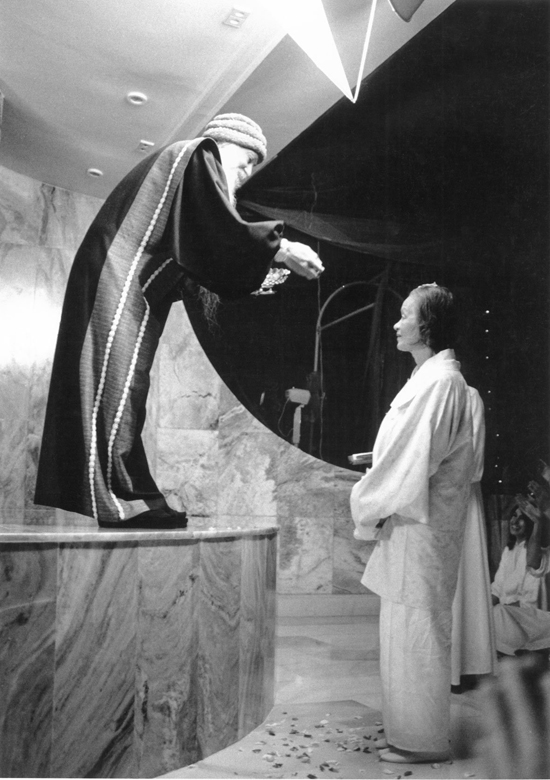
Osho walked to the edge of the podium and gestured to Tamo–San to come to him. She gracefully got up and stood in front of him, smiling up at him. He took the bowl from Anando, picked up a handfuls of rose petals and gently showered Tamo–San with the petals. When they were finished he namasted to her, she bowed in the Japanese way to him and they both returned to their seats. I was transfixed. What was I witnessing? There seemed to be a transmission without words, a conveying of knowing and understanding – and an exchange of infinite love.
Tamo–San left the next day without saying a word of what had transpired.
--Veena
==============================================================================================================================================

Veena remembers Tamo San’s visit to Pune and her own visit to her house in Japan

I was recently discussing climate change with my brother and suddenly started telling him about the mysterious visit of an enlightened Japanese woman to Osho in Poona in 1989 and my subsequent visits to her in her beautiful little temple in Enoshima, near Kamakura, where I lived for 5 years. He was uncharacteristically silent when I finished and then said, ‘You must write that down. It is such a beautiful story, it should not be lost!’

Osho showering rose petals on Tamo San

So, here is the story…

We were sewing peacefully in the sewing room in Lao Tzu House when there was a call for Japanese Geeta to come immediately to Neelam’s office. Someone had arrived and her translating help was need.

On her return, Geeta told us that an old Japanese lady called Tamo-San, a priestess from a temple near Kamakura, south of Tokyo, had arrived with three disciples. She had explained that she had come to visit Osho to give all her energy to him as he could reach people worldwide in a way that she could not. We were awed to hear this amazing story and were very curious to see how Osho would respond.

In Buddha Hall that evening, waiting for Osho to arrive, I could see the exquisite tiny lady sitting in the front row with her disciples. She seemed so light and so full of light and so very still. After Osho had greeted us he walked to the edge of the podium and gestured to Tamo-San to come close. She gracefully got up and stood smiling up at him. Anando quietly stood up too and I could see she was holding a beautifully decorated brass bowl.

Osho took the bowl from Anando, picked up a handful of the rose petals it contained, and gently showered Tamo-San with the petals. He then namasted to her, she bowed in the Japanese way to him, and they both returned to their seats.

I was transfixed. What was I witnessing? There seemed to be a transmission without words, a conveying of knowing and understanding – and an exchange of infinite love.
Tamo-San left the next day without saying a word of what had transpired.

I never forgot the wonder of that moment and when I went to Japan a few years later and heard that Tamo-San was living in a small temple in a nearby village, I of course went to see her. Three western sannyasins who were also living in Kamakura – we were all teaching English – came with me.

It was a wintery afternoon when we arrived at the beautiful, old, thatched building set in a Japanese garden. The entrance was in the traditional style: one took off one’s shoes on one level and then stepped up to another level which was covered in tatami mats and slipped one’s feet into the slippers offered to guests. We were then welcomed by Tamo-San’s daughter who spoke quite good English.

First we went into the temple where people were meditating. A faint fragrance of Japanese incense hung in the air and Tamo-San was – it is hard to explain – kind of singing a chant, creating sounds unfamiliar to my western ears. She was, apparently, famous for this kind of chanting. Sitting there I felt the same kind of energy that I had felt when sitting with Osho –although it was lighter and softer, maybe because she was a woman and older.

After the short ceremony, Tamo-San got up and welcomed us by giving us all an incredibly strong hug, surprising for its strength considering her size and age. This, we learnt later, was how she transmitted energy to people, as well as with her singing.

She gave us water to drink which, she told us, came from a sacred well in the temple grounds and contained healing properties. She then took us into her inner sanctuary to show us her shrine. In the centre was a statue of Buddha. On his left was a Christian crucifix and on his right was a picture of Osho. She touched each one gently and told us that these were the three most important beings the world had ever known and that she meditated on them every day.

I was stunned. I felt I was getting a tiny glimpse of a great mystery – particularly where Osho was concerned. How was this eight-five year old lady, who spoke no English and who lived in comparative isolation in a tiny village in Japan, so clear and sure about Osho’s importance in this world, equating him with Buddha and Christ? And what existential force or knowledge directed her to leave her sanctuary, get on a plane and go to Poona to see Osho for an evening and then leave? It was a huge journey for such a frail old lady. This was all far beyond my understanding.

We also learnt something quite unexpected. It seemed that after getting a university degree in ecology, Tamo-San had spent much of her life campaigning tirelessly in Japan and many other countries for people and their leaders to wake up and do something about the damage we were causing to the environment. We were shown some albums of photos and newspaper clippings of her as a young woman leading rallies to raise awareness about saving the planet. She had also written a small book, the title of which, translated into English, was ‘Stop the Boat!’ On the cover there was a sketch of people in a boat sailing towards a weir. The people in the boat were facing the other way, unaware that disaster was only a few minutes away.

Then the daughter, who did not seem to share Tamo-San’s love for Osho and was rather abrupt with us, made it clear that she felt we had had enough attention and should now leave. Tamo-San, however, had other ideas and created considerable consternation when she told her disciples that she wanted us all to stay for dinner. Not only that, she wanted to make us a treat called mulchi, which is a Japanese sweet tasting rather strange but quite delicious.

I can’t find the words to express how incredibly sweet Tamo-San was – playful, childlike, delicate, gentle – but incredibly strong. She delighted in cooking for us and watching us eat the food she prepared for us.

Then it really was time to go so once more she gave each one of us her incredible hug and we were ushered to the front entrance where we took off the slippers and stepped down onto the ground to put on our shoes. Our state of gentle bliss was further increased by the sight of snowflakes silently falling. We gazed in awe at the now altered garden and trees, all powdered with glistening new snow.

Then there was a call. We turned back to look at the entrance and Tamo-San was there, gesturing us to wait. She then disappeared and we stood for a while in the falling snow. We heard her softly singing before she re-appeared in the entrance – as if on a stage – and proceeded to dance a delicate stately dance for us, accompanying herself with her own song. She ended by kneeling down and bowing to us, then got up and waved as she floated back into the house.

Needless to say we were all in tears at the incredible beauty and energy we had just been part of. We, too, floated back home.

Text by Veena – first published in OSHOinUK in January 2008 and soon to be published as a chapter in Veena’s upcoming new book Glimpses of my Master

========================================================================================
Ma Anand Sarita
Later, I visited her in Japan. She had an altar with pictures of Buddha and Osho. Her way of working was very interesting. She was a tiny woman but with superhuman strength. She would pick up a huge grown man, give him a powerful blow on the back and put him back down. She did this to me and I was reeling from the lightning bolt of energy that ran through my body for days afterwards! Tamo san left her body on 21st November 2001.

Tamo san says:

“In the old days, evil things spread rapidly, but now good things spread rapidly. If you understand…everything begins to appear wonderful and beautiful, and it naturally makes people stop wasting or stop desiring unnecessary things. This awakening is contagious and it will be transmitted to everybody soon.”


Tuesday, 28 July 2020

Osho Jaw Bone Operation without Anesthetic

Various small operations on his teeth were done and also two bigger operations, one of which I was involved in indirectly because I was a good friend of the doctor who operated. 

Dr Modi was a specialist who operated on the bones of the jaw. He had studied in London and was specialized in surgery on the face, working

for many years in England. In Pune he had a private clinic and was considered one of the great Indian surgeons. His wife Zareen had become a disciple of Osho many years before and between us a very deep friendship was born, which continues up to the present, decades later. So I got to know him through her. His mentality was very Western, and his English sounded more like Oxford than Pune. He had never accepted Osho as a Master, unlike Zareen, who left the family and came to live in the commune.

Dr Modi loved horses, and had a sizeable mansion in the city in the colonial style of the English, with a beautiful garden. Being with him nourished me a lot due to his great culture and intelligence. We often talked for hours, passing on information about anything from pharmaceutical drugs to Indian philosophy and gardening.

He had the face of a North Indian, with a wide forehead and small lips that were clearly articulated and often bathed in a glass of whiskey, then busy with a cigarette, and very big black eyes that shone with the light of an intelligence that separated him from the rest of the world. Modi was out of place in India and in his depths he felt like a Westerner who was forced to live there. He didn't like all the poverty or the religious aspects that characterized the continent. In his soul, he was much closer to European existentialism than to the Hinduism of the Indian masses.

Since Osho's time in American prisons, the infections that had begun in his ear and jawbone were spreading dangerously toward the cerebral cavity. So Amrito decided to call Dr Modi. After

a medical visit, he decided to operate as soon as possible. That morning, before entering Lao Tzu, Modi came to see me and shared the tension he felt in having to operate on a man like Osho. After a brief exchange he asked me where he could find me after the surgery was over, because he wanted spend a little time with me before leaving the ashram.

He came to see in my office after about three hours. He was very shaky and vulnerable, as I had never seen him before. After all, he was a surgeon with a firm hand and an iron will. He hugged me, breaking out in tears in my arms. He wasn't able to understand how it was possible, what he had experienced in that small operating theatre. He told me that when everything was ready, he told Osho that he would give him an anaesthetic injection

and that after a few moments he wouldn't feel anything, and then he would start operating. But Osho refused to receive the injection.

Modi responded with all the authority of a famous surgeon and said to him: "Here I am the surgeon and I say we have to give you the anaesthetic and it is not a matter of discussion." But Osho looked at him and answered: "You are the surgeon but I am the Master and I am telling you to operate without an anaesthetic, starting when I give you the signal with my finger."

Modi felt cornered. From one side he knew that surgery on the face was extremely painful and that it wasn't practical to do it without anaesthetic, but from the other side he couldn't refuse because, after all, Osho was the master of his own body and also a spiritual Master who knew what

was happening beyond the physical body and the mind. Modi was petrified by the idea of operating without an anaesthetic on open bones, but he followed Osho's orders and performed the whole operation without a drop of anaesthetic.

Osho, shortly after closing his eyes, made a movement with his finger, giving the okay to start the operation, leaving his physical body in the hands of Dr Modi. After the operation, Osho re-entered his body and calmly opened his eyes. Modi was shaken, knowing that what had just happened wasn't understandable within the realm of normal science and that Osho's behaviour had put in question all his medical convictions about operating without an anaesthetic.

He continued to repeat to me, like a recording, "It's not possible." He was absolutely shocked at

having operated without an anaesthetic and he continued to be agitated for a long time.

As soon as he managed to relax, we went together for a drink at one of the ashram bars. It was an interesting moment, watching Dr Modi recover from this experience that could have changed his life forever. But instead, his ego reclaimed control with explanations generated by his strong rational mind.

The truth is, Osho was always a Master, not only when he came to speak with us and share his state of meditation. Osho was permanently in a state of total disconnection from the false reality of the ego and he took advantage of every situation in order to be able to teach something to people who came near him, even to the detriment of his body.

Osho respected Dr Modi very much and privately told Zareen a few times he would be happy if her husband took sannyas. But in spite of all these doors being opened in front of him, Modi never became a disciple. Because of his intellectual ego, he never could make the jump from the mind to the heart, the jump from the outsider to the disciple, the jump of a lover who lets go into existence, without any resistance.

Osho's body was sick and weak and his consciousness had a lot of difficulty staying in his body. This, as he told us on more than one occasion, is a difficulty that faces many Masters. The process of enlightenment breaks identification with the body, as well as the mind, and few have the capacity to remain in the body after such an experience. The physical body is heavy, gross and difficult to manage once you have entered into divine consciousness. There, the experience of bliss is so great there is no other choice but to stay in that state, not having any interest in physical activity.


Neelam Osho's Secretary's Diamond gift

Neelam, Osho's Indian secretary after Sheela. This is what I remember of her story: Before Neelam became a disciple in the '60s, her husband knew Osho and participated in meditation retreats with him.

 After a while, he tried to persuade his wife to come and meet the guru with whom he was infatuated. She wasn't interested. She only wanted to be a wife and mother. For Westerners who will read this account, it is worth mentioning that almost everyone in India has a guru to consult or worship. Whatever your caste or social status, rich or poor, businessman or farmer, you had access to some kind of guru.Even today, though India has evolved socially and economically, Indian families all have their guru, with whom they consult when it's time for the daughter to marry, or for advice on investment decisions or other important matters. 

The First Door that I mentioned in this book, the door of devotion, is an experience grounded in centuries of understanding for Indians, who don't have a problem with kneeling on the ground and touching the feet of a person in whom they recognize a spiritual quality. 

So Neelam assumed Osho was just one of the many gurus who went around India giving advice to people, with no special quality, and she didn't feel attracted to this world. But, after many months of persistence on the part of her husband, she agreed to go and see Osho. 

At that time Osho used to lead meditation camps, experimenting with various meditation techniques that he subsequently developed and perfected, and which were ultimately used in the commune from 1974 onwards. During breaks between his discourses and the meditations, many Indians got in line to receive his blessings, including not only those participating in the meditation camp but also people passing by, who, realising a guru was available, would stop to touch his feet. 

Neelam got in line with her husband. When it was her turn, she fell at Osho's feet, almost fainting, and remained there for a long time. She was utterly stunned by the force of the Master and from that moment stayed close to him. Even after Osho's death, Neelam stayed in the Pune commune for nine more years, then left to construct a new meditation centre close to Dharamshala, in the Himalayas.

In India, it is a tradition that when you find a Master you bring him a gift as a symbol of your recognition. Neelam and her husband spent days thinking what they could give him, and in the end they decided to bring him a diamond ring that had belonged to her mother and her mother's mother. It was the most valuable and precious thing she had, and she wanted to send a signal to Osho that her devotion was total. 

So at the next meditation camp they brought the famous family diamond. Neelam got in line with the others and when her turn came she kneeled down to touch the feet of the Master, then gave him the box with the diamond in it. Osho looked at it, brought it near to him and blessed Neelam by touching her head. She moved away in order to give space to the next person in line, who was a passer-by, like many others who were taking advantage of the situation in order to receive blessings from the guru. This man was not one of his followers. 

Osho also blessed him, and then gave him the diamond he had just received from Neelam!The man was there only by lucky coincidence, and he was given her precious diamond! Neelam was very shocked by this incident but nevertheless continued in her devotion to the Master. About twenty years after the ring incident, Osho reminded Neelam of the gift of the diamond.

He told her, "If you give an object to someone as a sign of love, you need to totally let go of it, otherwise it is just an attempt to tie that person to you." He had waited almost twenty years to make sure the teaching was understood, then closed the circle by explaining the message behind his act.

For thousands of people – whether they had money or not – the Ranch experience was one huge opportunity to see their attachments and their desires. It was another chance to be total in giving, in love, without expecting anything in return. 

Real love is in fact a gesture that manifests naturally in the fullness of the heart –the heart full of nectar, full of joy in sharing, full of divine energy that isn't personal, a heart that overflows and shares with everyone without discrimination.

 The Master, by the simple fact of his being, like the sun or the stars, lights the way for those who open their hearts to this light. His giving is not an intentional act; he's not thinking, "Now I will work on Tom, Dick and Harry because they need to change their attitude toward life, or because they need to open up to love." Osho simply let the energy flow, interfering in the stream of events as little as possible. 

With this in mind, it becomes clear that all the criticisms that were levelled at Osho after the Ranch were just hollow words blowing in the wind. From the standpoint of the growth of human consciousness, it didn't matter that Osho committed practical errors, because, as he himself said: "I am not God! I am a human being with his limits."

This needs to be remembered, because many people expected Osho to be infallible, that he should have seen the future and interfered to save his commune. But all these ideas were just a projection of the mind of individual disciples who imagined that their Master was a special being like God, mainly because it satisfied their egos. 

Osho perhaps made errors in calculating and anticipating events, but this doesn't take anything away from his message, his teachings and his energetic presence. The change that is experienced with a Master happens through work done by the individual, by the lone disciple, on himself. It is for this reason that the spiritual path is a solitary path, because it depends totally on us – how much energy and awareness we put into the process of transformation. 

If the disciple is closed, a real Master cannot do anything, while a false master may try to persuade or push the student toward change according to the direction he thinks is right. Osho, Lao Tzu, Krishnamurti, Gurdjieff, Chuang Tzu, Socrates, Saint Francis, Buddha, Mahakashyapa and all authentic Masters have never forced anyone. They never promised anything to their disciples; they simply remained available, and whoever was alert enough could feel the fragrance of their spirit.

 Of course, disciples who lived through the events that took place in the commune while remaining identified with their own vested interests, their own ego attachments, could only suffer feelings of betrayal. But the Master, in his compassion, never compromises.

 In August, 1986 at Juhu Beach, Mumbai, when he started talking again, after having flown the skies of the planet and been in half-a-dozen jails, Osho declared: "Now I finally have my disciples. I have had to dirty my hands working in the mud for decades, looking for my real disciples. Now that the base of the temple has been built I will raise the temple for all myreal disciples, those alive now and those coming in future generations. Like a fisherman who throws his net, I am now pulling it up, and I find myself with the people that remain with me because they are my real disciples." 

When he pronounced these words we were crammed in the living room of the Indian disciple who offered his house to the Master. We were about forty people, of which only five or six were Westerners, and the rest Indians. In the following days, slowly, day after day, many old sannyasins arrived, and in the space of six months hundreds of devotees came back to the feet of the Buddha, having passed through one of the most intense spiritual devices ever to take place on such a scale.

On January 4th of 1987, we returned to the old commune in Pune in order to live with him the last three years of his stay in the physical body.

Monday, 27 July 2020

Prem Azima: Death Of Ego , Straying from path

On the path of meditation, initially it is

important to clean the layers of the normal mind and the personal unconscious, so that repressed emotions and negative attitudes don't block the flow of energy. 

When the mind is relatively clean, the second stage starts. This is the true state of meditation in which we begin to enter the space of No Mind. After experiencing short gaps – moments in which the thinking process stops – we gradually find that we can spend longer and longer periods in the state of meditation and its accompanying states of bliss and peace. 

According to Osho, these spaces of awareness can be of two kinds: implosive or explosive. In the first, we begin to feel the body getting smaller and smaller, finally disappearing and dissolving into nothingness, imploding into an experience of emptiness. 


In the second case, we experience the body expanding in space and continuing to spread and grow until it loses all definition, melting and dissolving into a vast emptiness. These are two ways of experiencing the same thing. Either way, emptiness is the final destination.


 I don't want to seem discouraging, but the possibilities and opportunities for giving up on the path of meditation are infinite. The ego, the personality structure with which we are identified, will do everything in its power to divert our consciousness from the path that leads inside to our being.

In these 35 years that I have continued to walk the path of inner exploration, I have seen thousands of people abandon the path with a wide range of excuses. For example, many who become curious about meditation are not open

to changing their lives. They cling to the security of a steady job or a settled love relationship. The problem is that, sooner or later, spiritual growth requires radical change, often in the spheres of work and relationships. This is not always the case, but as a general rule it's true.

The true spiritual path is a path of death;

death of the person whom we think ourselves to be; death of the ego structure that seems to protect us but in reality keeps us insulated from life; death of all that is false as it burns in the flame of consciousness; death of relationships to which we cling when love has gone, out of a fear of being alone; death of the past and future as we embrace the present moment.

Death of the ego and the rebirth of the 'I,' the real 'I,' the 'I' that none of us yet knows because we haven't asked the fundamental question in this life: "Who am I?"


Prem Azima on Meditation

Only through meditation can he begin to have experiences of 'No Mind.' In the process of meditation, when we first sit down and close our eyes, the rational layer of our mind continues to be very active. Then, after a certain period of time, which will vary from person to person, the thinking mind begins to slow down. According to Osho, it takes about forty minutes before the mind enters a relaxed state and the production of thoughts starts to diminish. When this happens, if we remain centred in the observer,

or witness, we begin to observe the space of inner emptiness that brings peace. We become less aware of the body, more detached from our emotions, less preoccupied by thought.

It is an interesting fact that the chattering mind cannot easily exist in the present moment. It needs to focus on either past memories or future expectations in order to continue. When we enter meditation, the present moment begins to manifest, allowing us to experience that it is beyond both time and space.

The physical location of the meditator begins to lose its boundaries and it becomes easier to access images and dimensions which are beyond the current time-space continuum. From this perspective, people who engage in channelling are simply connecting with these other levels and allowing

themselves to be used as vehicles to bring news and messages from these dimensions. When we speak of No Mind it indicates a state of consciousness in which the intermediate layer, the thinking mind, is no longer so active – or is altogether absent. This allows us to experience higher levels of mind, gaining confidence in spaces and dimensions to which we are not accustomed and which might otherwise scare us.

The more we let go of the ego and the identity we have borrowed from society, the closer we come to our centre and our authentic self. It's a paradox. The ego promises to give us a clear sense of who we are, but fails because everything it claims for itself is borrowed. The dissolution of the ego looks like the end of the 'I' but in reality gives us a deeper more authentic sense of who we really are.

If there is an effort to control, then the state of No Mind is absent. If No Mind manifests, there is no control; we simply keep the flame of the observer burning without choice, ready to reflect whatever experience manifests before us. This attitude of non-interference is a far cry from conventional Western culture, which is based on self-determination, making plans, creating change and generally trying to manipulate the world that surrounds us as much as possible.

To decide to begin a spiritual journey of self-discovery is to go against the current of our mainstream culture. It is a journey that few initiate and even fewer pursue to a conclusion. The path of dis-identification is arduous, not least because our families, our friends, our teachers, our priests and politicians are all dedicated to the task of keeping us identified with the values of the society in which we find ourselves. They don't want us to change because this might cause them to question their own values and this, in turn, creates fear. So we are, in fact, swimming against the current of the collective mind of all human beings that surround us.