Monday, 3 August 2020

Ma Taru & OSHO

Talk with Taru after discourse. She’s the jovial Indian lady who sings the sutras at the beginning of the Hindi lectures. She lives in ‘my’ guest room; an extra-large force of nature; funny, clever, full of life. She first came to Osho in 1963. We sit cross-legged opposite each other and she starts talking about the old days. Osho had left his family already at the age of seventeen. He was never much of a family-oriented person. Apparently, his sister looked after him and worked as a teacher to finance his studies.


Taru first met Osho at a panel of public lectures given by different teachers. She was drawn to him from the first moment when she heard him speak – he was so very different from the other panel-members. Among the gurus and pundits, Osho was exceptional.

She said that she had once met him on the street in Bombay, just before the Indian New Year celebration. He was carrying bags in each hand, with bottles of gin and whisky, and he asked her to come and see him later that day, at five. Together with her daughter, she sat before Osho.

“He pulled me closer and put his thumb on my third eye and I was gone… I was seeing green meadows and flowers, a blue river – I was in paradise! When it was over and I was so shaken up, Osho just smiled. ‘You will be with me for always, this is not the first time that you are with me.’ After that, I was looking after his household. My husband supported me, and he himself became Osho’s doctor.”

At that time, Osho was physically very active. “He didn’t declare his enlightenment to us and even though we knew that we were spending time with someone special, we never imagined that he was enlightened.”

She’s an imposing phenomenon, Taru, as she sits there on the bed. When she wants to emphasise something, she whacks me on the thigh, and when she tells of how Vivek took over her job as housekeeper when Osho came to Poona, the tears begin to roll down her cheeks.

Osho never had any money with him, she told me, but he always expected that we would bring him only the best of the best. He wore the finest cloth, the priciest shoes and loved exquisite food. Rich followers used to finance his constant travels all over India, and the apartment in Bombay, and his enormous collection of books, crates of which were often sent along with him on his journeys.

Taru swore that all rumours about Osho and sex were pure imagi- nation.

“I’ve met a few women who insist that they have slept with Osho. It’s not that they are consciously lying, more like they are fantasising about Osho when they are actually in bed with their own husbands!”


Saturday, 1 August 2020

Tamo San and OSHO

When she reached the age of twenty two, when she was to be ordained by the Nishi Honganji head temple of the Jodo-Shinshuu sect. While waiting in the room before the ceremony, the scroll on the wall said, “Seeing the Truth”, suddenly broke into millions of golden particle, and streamed into her body.

She saw the birth of the universe, everything in the universe and how things appeared to be separated from one another, where they are actually inseparable. Everything is essentially light and light is inseparable.

She saw that it is an illusion to think of ourselves as separate human beings, when in truth, we are born of the same life force. All of the information that poured into her mind, was so huge that it took her about ten days to assimilate.
After that experience, she understood her calling. In order to bring about everlasting peace on earth, all of mankind needs to be awakened. There is no other way! She knew that the experience she had, must be shared by every man on earth, otherwise suffering of all the living beings including the planet will never cease.

Tamo-san said, that it will take time for all of mankind to be awakened, but when it happens, it happens to all of us simultaneously. The darkest time of the day is right before dawn. Now is the dark time, so the dawn is near.
==============================================================================================================================================
Reverend Ryoju Kikuchi, a Japanese woman also known as Tamo-san, visited Pune and on the 29th of November 1989, during the meeting of the White Robe Brotherhood in Buddha Hall, Osho showered rose petals on her, acknowledging her enlightenment. Osho also gave her a copy of The Zen Manifesto, with a certificate which read, "I, Osho, as a buddha in my own right, recognise and rejoice in your enlightenment. I know, and you must be knowing, that there is one step more - going beyond enlightenment, and being nothing."
Tamo-san came to Poona because she heard Osho′s health was in danger. "I came to give my energy to Osho so that his strength would come back. He can make a big change in the world. I want to make sure that he will be well," she said.
Long time ago (1957), Tamo-san published a book, called Moor The Boat, giving her view on the world situation we are facing right now.

==============================================================================================================================================
We were sewing peacefully in the sewing room in Lao Tzu House when there was a call for Japanese Geeta to come to Neelam’s office. Someone had arrived and translating help was need. On her return Geeta told us that an old Japanese lady called Tamo–San, a priestess from a temple near Kamakura, south of Tokyo, had arrived with three disciples. She explained that she had come to visit Osho to give all her energy to him as he could reach people worldwide in a way that she could not. We were awed to hear this amazing story and were very curious to see how Osho would respond. In Buddha hall that evening I could see the exquisite tiny lady sitting in the front row with her disciples. She seemed so light and so full of light and so very still. When Osho walked on to the podium, unusually Anando came with him. I saw that she was carrying a beautifully carved brass bowl.
Osho walked to the edge of the podium and gestured to Tamo–San to come to him. She gracefully got up and stood in front of him, smiling up at him. He took the bowl from Anando, picked up a handfuls of rose petals and gently showered Tamo–San with the petals. When they were finished he namasted to her, she bowed in the Japanese way to him and they both returned to their seats. I was transfixed. What was I witnessing? There seemed to be a transmission without words, a conveying of knowing and understanding – and an exchange of infinite love.
Tamo–San left the next day without saying a word of what had transpired.
--Veena
==============================================================================================================================================

Veena remembers Tamo San’s visit to Pune and her own visit to her house in Japan

I was recently discussing climate change with my brother and suddenly started telling him about the mysterious visit of an enlightened Japanese woman to Osho in Poona in 1989 and my subsequent visits to her in her beautiful little temple in Enoshima, near Kamakura, where I lived for 5 years. He was uncharacteristically silent when I finished and then said, ‘You must write that down. It is such a beautiful story, it should not be lost!’
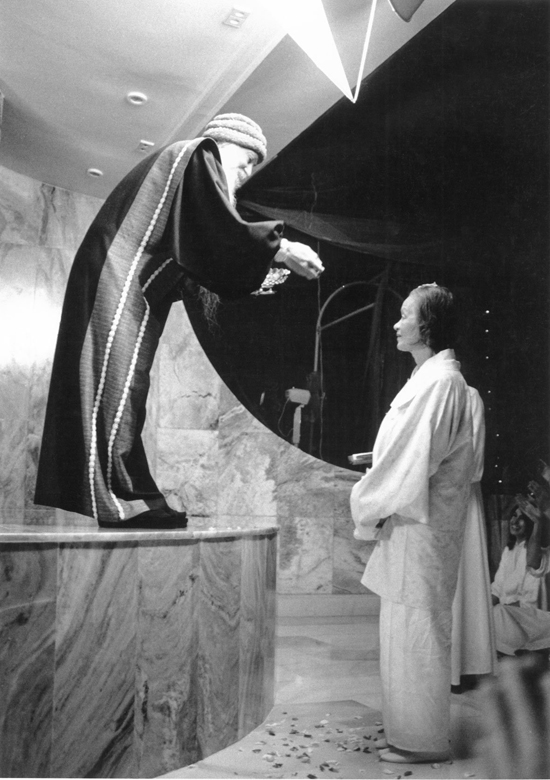
Osho showering rose petals on Tamo San

So, here is the story…

We were sewing peacefully in the sewing room in Lao Tzu House when there was a call for Japanese Geeta to come immediately to Neelam’s office. Someone had arrived and her translating help was need.

On her return, Geeta told us that an old Japanese lady called Tamo-San, a priestess from a temple near Kamakura, south of Tokyo, had arrived with three disciples. She had explained that she had come to visit Osho to give all her energy to him as he could reach people worldwide in a way that she could not. We were awed to hear this amazing story and were very curious to see how Osho would respond.

In Buddha Hall that evening, waiting for Osho to arrive, I could see the exquisite tiny lady sitting in the front row with her disciples. She seemed so light and so full of light and so very still. After Osho had greeted us he walked to the edge of the podium and gestured to Tamo-San to come close. She gracefully got up and stood smiling up at him. Anando quietly stood up too and I could see she was holding a beautifully decorated brass bowl.

Osho took the bowl from Anando, picked up a handful of the rose petals it contained, and gently showered Tamo-San with the petals. He then namasted to her, she bowed in the Japanese way to him, and they both returned to their seats.

I was transfixed. What was I witnessing? There seemed to be a transmission without words, a conveying of knowing and understanding – and an exchange of infinite love.
Tamo-San left the next day without saying a word of what had transpired.

I never forgot the wonder of that moment and when I went to Japan a few years later and heard that Tamo-San was living in a small temple in a nearby village, I of course went to see her. Three western sannyasins who were also living in Kamakura – we were all teaching English – came with me.

It was a wintery afternoon when we arrived at the beautiful, old, thatched building set in a Japanese garden. The entrance was in the traditional style: one took off one’s shoes on one level and then stepped up to another level which was covered in tatami mats and slipped one’s feet into the slippers offered to guests. We were then welcomed by Tamo-San’s daughter who spoke quite good English.

First we went into the temple where people were meditating. A faint fragrance of Japanese incense hung in the air and Tamo-San was – it is hard to explain – kind of singing a chant, creating sounds unfamiliar to my western ears. She was, apparently, famous for this kind of chanting. Sitting there I felt the same kind of energy that I had felt when sitting with Osho –although it was lighter and softer, maybe because she was a woman and older.

After the short ceremony, Tamo-San got up and welcomed us by giving us all an incredibly strong hug, surprising for its strength considering her size and age. This, we learnt later, was how she transmitted energy to people, as well as with her singing.

She gave us water to drink which, she told us, came from a sacred well in the temple grounds and contained healing properties. She then took us into her inner sanctuary to show us her shrine. In the centre was a statue of Buddha. On his left was a Christian crucifix and on his right was a picture of Osho. She touched each one gently and told us that these were the three most important beings the world had ever known and that she meditated on them every day.

I was stunned. I felt I was getting a tiny glimpse of a great mystery – particularly where Osho was concerned. How was this eight-five year old lady, who spoke no English and who lived in comparative isolation in a tiny village in Japan, so clear and sure about Osho’s importance in this world, equating him with Buddha and Christ? And what existential force or knowledge directed her to leave her sanctuary, get on a plane and go to Poona to see Osho for an evening and then leave? It was a huge journey for such a frail old lady. This was all far beyond my understanding.

We also learnt something quite unexpected. It seemed that after getting a university degree in ecology, Tamo-San had spent much of her life campaigning tirelessly in Japan and many other countries for people and their leaders to wake up and do something about the damage we were causing to the environment. We were shown some albums of photos and newspaper clippings of her as a young woman leading rallies to raise awareness about saving the planet. She had also written a small book, the title of which, translated into English, was ‘Stop the Boat!’ On the cover there was a sketch of people in a boat sailing towards a weir. The people in the boat were facing the other way, unaware that disaster was only a few minutes away.

Then the daughter, who did not seem to share Tamo-San’s love for Osho and was rather abrupt with us, made it clear that she felt we had had enough attention and should now leave. Tamo-San, however, had other ideas and created considerable consternation when she told her disciples that she wanted us all to stay for dinner. Not only that, she wanted to make us a treat called mulchi, which is a Japanese sweet tasting rather strange but quite delicious.

I can’t find the words to express how incredibly sweet Tamo-San was – playful, childlike, delicate, gentle – but incredibly strong. She delighted in cooking for us and watching us eat the food she prepared for us.

Then it really was time to go so once more she gave each one of us her incredible hug and we were ushered to the front entrance where we took off the slippers and stepped down onto the ground to put on our shoes. Our state of gentle bliss was further increased by the sight of snowflakes silently falling. We gazed in awe at the now altered garden and trees, all powdered with glistening new snow.

Then there was a call. We turned back to look at the entrance and Tamo-San was there, gesturing us to wait. She then disappeared and we stood for a while in the falling snow. We heard her softly singing before she re-appeared in the entrance – as if on a stage – and proceeded to dance a delicate stately dance for us, accompanying herself with her own song. She ended by kneeling down and bowing to us, then got up and waved as she floated back into the house.

Needless to say we were all in tears at the incredible beauty and energy we had just been part of. We, too, floated back home.

Text by Veena – first published in OSHOinUK in January 2008 and soon to be published as a chapter in Veena’s upcoming new book Glimpses of my Master

========================================================================================
Ma Anand Sarita
Later, I visited her in Japan. She had an altar with pictures of Buddha and Osho. Her way of working was very interesting. She was a tiny woman but with superhuman strength. She would pick up a huge grown man, give him a powerful blow on the back and put him back down. She did this to me and I was reeling from the lightning bolt of energy that ran through my body for days afterwards! Tamo san left her body on 21st November 2001.

Tamo san says:

“In the old days, evil things spread rapidly, but now good things spread rapidly. If you understand…everything begins to appear wonderful and beautiful, and it naturally makes people stop wasting or stop desiring unnecessary things. This awakening is contagious and it will be transmitted to everybody soon.”